

Inside the Perimeter: A Field Guide to Private AI Adoption
The End of the Series, the Start of the Work Across this series we have argued for a specific position. Private AI — …


We made the case last week that a model you depend on can vanish on a timeline you do not set , and that the defense is being able to run somewhere else. That is true, and it is also only half of the problem. Pointing a request at a different model is a few lines of configuration. The expensive part is everything wired around the model: the tools the agent is allowed to call, the data connectors, the guardrails, and the interfaces your team spent months learning. If those are bolted to a vendor, then being “multi-model” buys you very little. You can change the engine and still have to rebuild the car.
This is the part of portability that most teams discover late. The model is the most visible dependency and the easiest to swap. The tool surface and the human surface are the ones that actually hold you in place.
When a company decides to go multi-vendor on AI, it usually does so by accumulation. One team adopts a vendor’s IDE. Another brings in a separate notebook product. A third buys an agent builder from someone else, and the support org stands up a fourth tool for chat. Each is reasonable on its own. Put together, they fragment two things that should stay stable.
The first is the tool surface, meaning the set of capabilities an agent can actually reach: your internal APIs, your databases, your document stores, your approval workflows, the policies that say what an agent may and may not do. Every vendor wires that surface to its own backend in its own way. Connect your CRM to the notebook tool, and you have not connected it to the agent builder. Write a guardrail in one, and it does not exist in the other. The work of integrating your systems and encoding your policy gets done once per vendor, inconsistently, and a year later nobody can answer the simple question of which tools which AI can touch.
The second is the human surface. Your people now operate four products with four mental models, four login flows, and four places where work lives. The cost shows up as context-switching, onboarding time, and the quiet workarounds people invent when the sanctioned path is too much friction. A developer who has to choose which of four tools to open for a task often chooses a fifth one you do not know about.
Both surfaces fragment for the same reason. The interface and the integrations were sold as part of the model, so they fragment along vendor lines the moment you use more than one model.
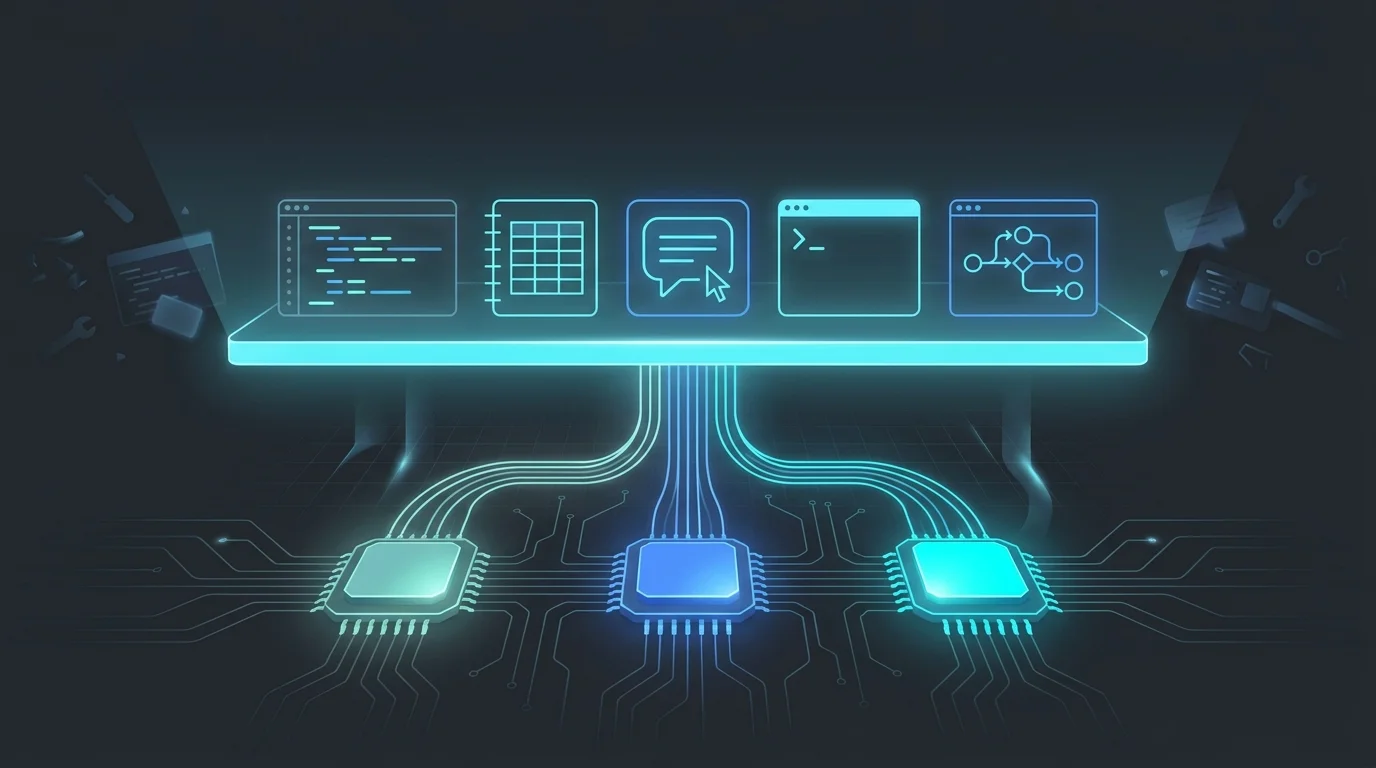
The answer is to stop buying the interface and the tool surface as accessories to a model, and to own them yourself as a layer that sits above any model. That is what the Calliope Workbench is. It bundles the interfaces a technical organization already knows, the IDE, the notebooks, the agent and workflow builders, the chat, the terminal, the data and document tools, on top of one common tool surface and one backend abstraction, all inside your perimeter.
Concretely, that changes where the work lives. You define the tool surface once. The connection to your CRM, the access to your document store, the policy about what can leave the network, the audit trail over every call: you set those at the platform, and they apply no matter which model is answering. You give your team interfaces they recognize instead of a vendor’s idea of how they should work. And when you add or change a backend, the tools and the interfaces do not move, because they were never the vendor’s to begin with.
This is the difference between bundling and a bundle. A vendor bundle is several of their products sold together. Bundling, the way we mean it, is taking the surfaces that your team and your agents depend on and making them independent of the model underneath, so the model becomes the interchangeable part.
Go back to the recall scenario. A backend gets deprecated, restricted, repriced, or pulled by a directive. In the multi-vendor world, that event takes out the model and the tool integrations and the interface together, because they shipped as one thing, and your continuity plan turns into a re-integration and retraining project under time pressure. In a bundled workbench, the same event is a configuration change. The agents keep the tools they had, the team keeps the screens they know, the policies keep applying, and a different model picks up the work.
Portability at the model layer is necessary. Constancy at the tool layer and the human layer is what makes the portability usable. One without the other is a promise you cannot keep when it matters.
All of this assumes a boundary. The reason the Workbench can present one tool surface and one consistent set of interfaces is the same reason it can keep your data inside your perimeter: it is your platform, running where you control it, rather than a set of outside services you federate and hope to govern. The single surface and the privacy come from the same decision. You stop renting the place your AI work happens, and the consistency, the governance, and the data residency stop being four separate problems you solve four separate times.
Plan for that. The frontier will keep moving, providers will keep adjusting access, and prices will keep falling and occasionally spiking. The pieces your team touches every day and the tools your agents call should not move every time the model does. Own the surface, bundle the interfaces your people already know, keep the whole thing inside your boundary, and let the model be what it should be: the easy thing to swap.
The End of the Series, the Start of the Work Across this series we have argued for a specific position. Private AI — …

Where the Perimeter Is the Hospital Healthcare networks operate inside a perimeter, even when most administrators do not …